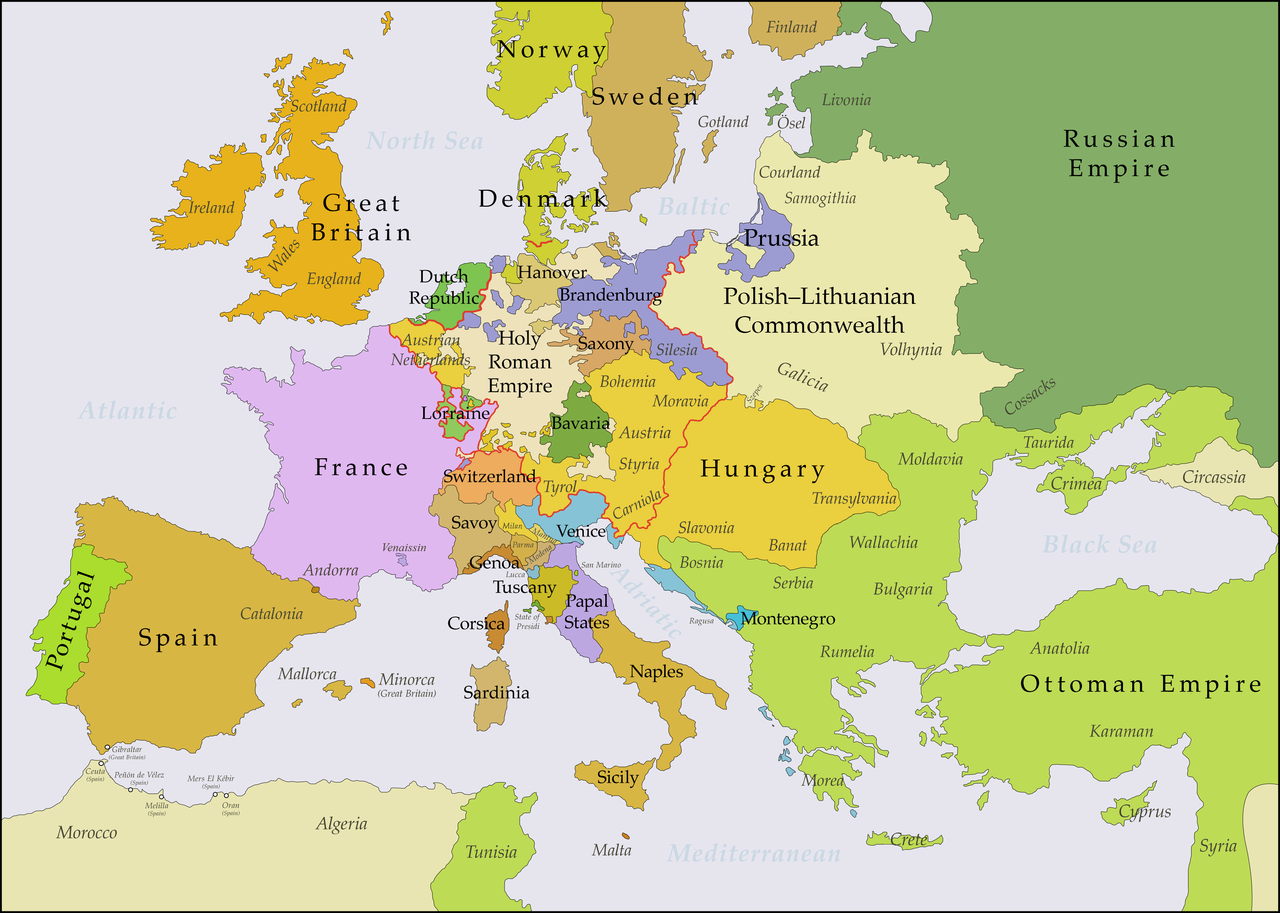
The Russo-Turkish War of 1768-1774 was a major armed conflict that saw Russian arms largely victorious against the Ottoman Empire. Russia’s victory brought Kabardia, part of Moldavia, the Yedisan between the rivers Bug and Dnieper, and Crimea into the Russian sphere of influence. Though a series of victories accrued by the Russian Empire led to substantial territorial conquests, including direct conquest over much of the Pontic–Caspian steppe, less Ottoman territory was directly annexed than might otherwise be expected due to a complex struggle within the European diplomatic system to maintain a balance of power that was acceptable to other European states and avoided direct Russian hegemony over Eastern Europe.
Nonetheless, Russia was able to take advantage of the weakened Ottoman Empire, the end of the Seven Years' War, and the withdrawal of France from Polish affairs to assert itself as one of the continent's primary military powers. The war left the Russian Empire in a strengthened position to expand its territory and maintain hegemony over the Polish-Lithuanian Commonwealth, eventually leading to the First Partition of Poland. Turkish losses included diplomatic defeats that saw its decline as a threat to Christian Europe, loss over its exclusive control over the Orthodox millet, and the beginning of European bickering over the Eastern Question that would feature in European diplomacy until the collapse of the Ottoman Empire in the aftermath of World War I.
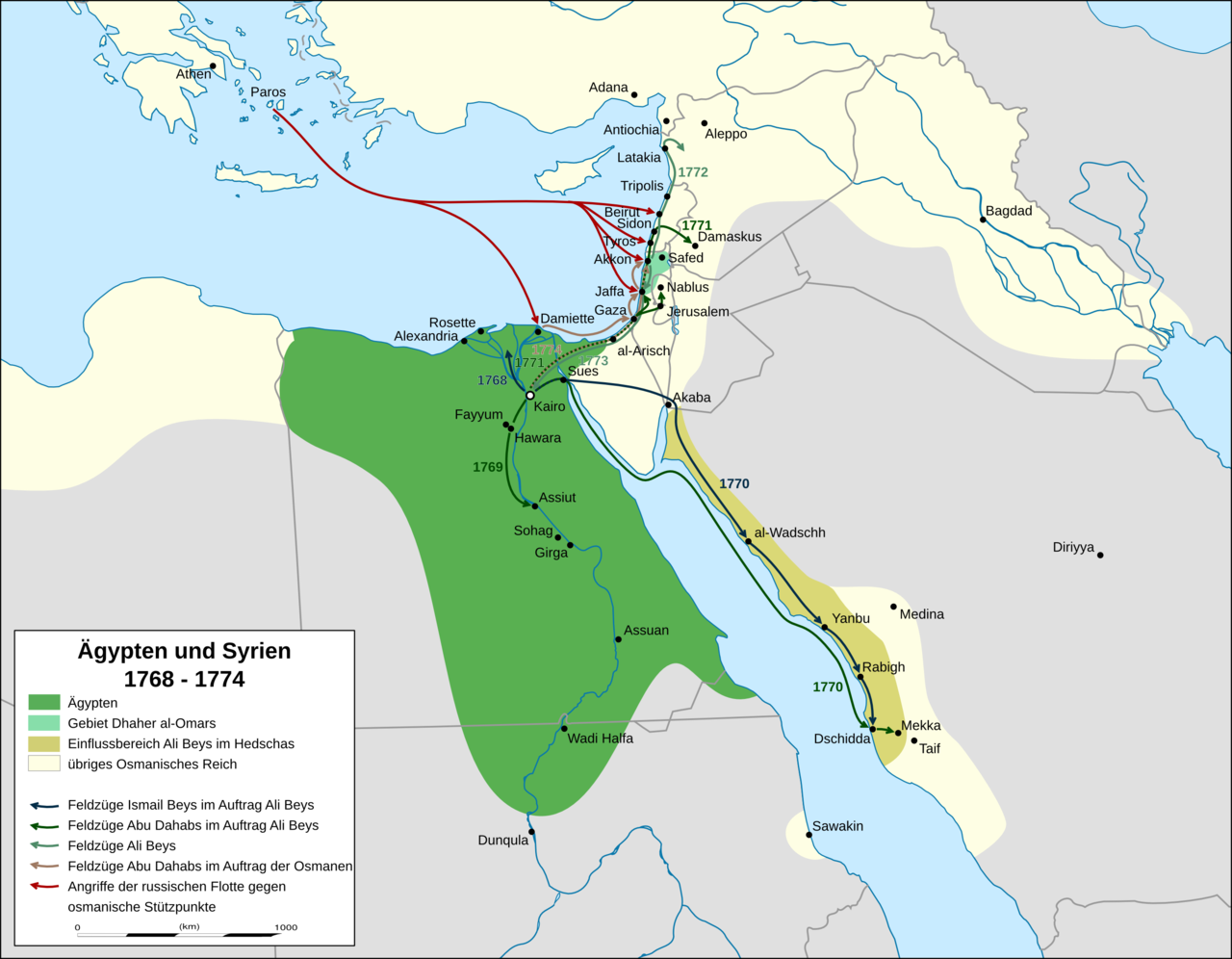
War in the Mideast: Russian fleet movements denoted by red arrows.
Background
Russian war with Poland
The war followed internal tensions within the Poland which indirectly challenged the security of the Ottoman Empire and its ally, the Crimean Khanate. The true power behind the Polish throne was the Russian ambassador Nicholas Repnin and the Russian army, with King Stanisław August Poniatowski being appointed due to his ties as former favourite to the Russian Empress Catherine II. Repnin had forcefully passed the Perpetual Treaty of 1768 between Poland and Russia, which was disadvantageous to Poland geopolitically, challenged the political supremacy of Poland's Catholic faith, prevented reform of the liberum veto, and allowed Warsaw's occupation by Russian troops. Rising unrest led to the massive revolt of the Bar Confederation, an alliance of noble, Catholic, and peasant rebels. In the fortified town called Bar, near the Ottoman border, the Bar Confederation was created on 29 February 1768, led by a landed Polish noble named Casimir Pulaski. While the Russian army heavily outnumbered the confederates and defeated them several times in direct battle in Podolia Ukraine, bands of rebels waged low scale guerrilla war throughout the Ukraine and southern Poland. On 20 June 1768, the Russian Army captured the fortress of Bar but when one band of surviving confederates fled over to the Turkish border, pursuing Russian troops clashed with janissary garrison troops. Polish revolts would dog Russia throughout the war and make it impossible for Catherine II to keep control of Poland.
Allegory of Catherine’s Victory over the Turks (1772). (LINK)
Ottoman situation
In the Ottoman Empire, revolts were widespread. Many noble factions had risen against the power of sultan Mustafa III and would proceed to break away from the Ottoman Empire. In addition to this decentralization of the Empire the Ottomans were also faced with the revival of a unified Persia, which rose to oppose the Turks in Iraq.
Upon the outbreak of the war the Ottomans seemed to have the upper hand as Russia was suffering from financial strain as a consequence of involvement in the Seven Years' War. The Turkish Navy capitalized on the inferiority of Russia's navy, even though it employed British officers to resolve this weakness. The Ottomans dominated the Black Sea, giving it the advantage of shorter supply lines. The Ottomans were also able to levy troops from their vassal state, the Crimean Khanate, to fight the Russians, but their effectiveness was undermined by constant Russian destabilization of the area. In the years preceding the war the Ottoman Empire had enjoyed the longest period of peace with Europe in its history (1739-1768). Nevertheless, the Ottoman Empire faced internal division, rebellion and corruption compounded by the re-emergence of a unified Persian leadership, under Nader Shah. One clear advantage for the Ottomans was its superior numbers as the Ottoman army was three times the size of its Russian counterpart. However, the new Grand VizierMehmed Emin Pasha would prove himself to be incompetent militarily. The Russian army massed along the borders with Poland and the Ottoman Empire, which made it difficult for Ottomans troops to make inroads into Russian territory.
Russian invasion
Not content to let the Polish enemy flee over the border, Cossacks followed them into the Ottoman Empire. Mustafa III received reports that the town of Balta had been massacred by Russian paid Zaporozhian Cossacks. Russia denied the accusations, but it was reported that the Cossacks "certainly razed Balta and killed whomever they found". With the confederates of Poland and the French embassy pushing the sultan along, with many pro-war advisors, the sultan on October 6 imprisoned Aleksei Mikhailovich Obreskov and the entire Russian embassy's staff, marking the Ottoman’s declaration of war on Russia.
After her victories in the war,Catherine IIwas depicted in portraits dressed in the military uniforms of Great Britain, which was initially a willing ally to Russia because of the trade between the two countries. Great Britain needed bar iron to fuel its ongoing Industrial Revolutionas well as other products such as sailcloth, hemp, and timber, for the construction and maintenance of its Navy, all of which Russia could provide. When the tide of the conflict turned in Russia's favour, Britain limited its support, seeing Russia as a rising competitor in Far Eastern trade, rather than merely as a counterbalance to the French navy in the Mediterranean. While Russia remained in a superior position in the Black Sea, the withdrawal of British support left Russia unable to do anything more than cut down its own supply lines and disrupt Turkish trade in the area.
On September 17, 1769, the Russians began their initial campaign over the Dneister into Moldavia. The elite Ottoman Janissaries took heavy casualties from the Russians at Khotyn but managed to hold on, and the remainder of the Ottoman army panicked and abandoned the field and the Russians claimed the fortress. With the Ottomans in disarray the Russians took the capital of Moldavia (Jassy) on October 7. They continued the advance south into Wallachia, occupying its capital Bucharest on November 17. From the capital of Bucharest, the Russians fanned out through the principality, only later being challenged by Grand Vizier Mehmed Emin Pasha at Kagul on Aug 1, 1770. The Russians routed the Grand Vizier's forces and allegedly one-third of the Ottoman troops drowned in the Danube trying to escape.
By now, Russia had some troops spread out north of the Caucasus. In 1769, as a diversion, the Russians sent Gottlieb Heinrich Totleben south into Georgia. He besieged Poti on the Black Sea coast, but the affair was mismanaged, and Russian troops were withdrawn in the spring of 1772. It was the first time Russian troops had crossed the Caucasus. On the steppes north of the mountains, the later-famous Matvei Platov and 2000 men fought 25000 Turks and Crimeans. The Cossack village of Naur was defended against 8000 Turks and tribesmen.
Russian Mediterranean expedition
During the war, a Russian fleet, under Count Alexei Grigoryevich Orlov, entered the Mediterranean Sea for the first time in history. It came from the Baltic Sea and was intended to draw Ottoman naval forces out from the Black Sea. In Greece, Orlov's arrival sparked a Maniot revolt against the Ottoman authorities. In 1771, however, the Russians abandoned Greece and the revolt was put down.
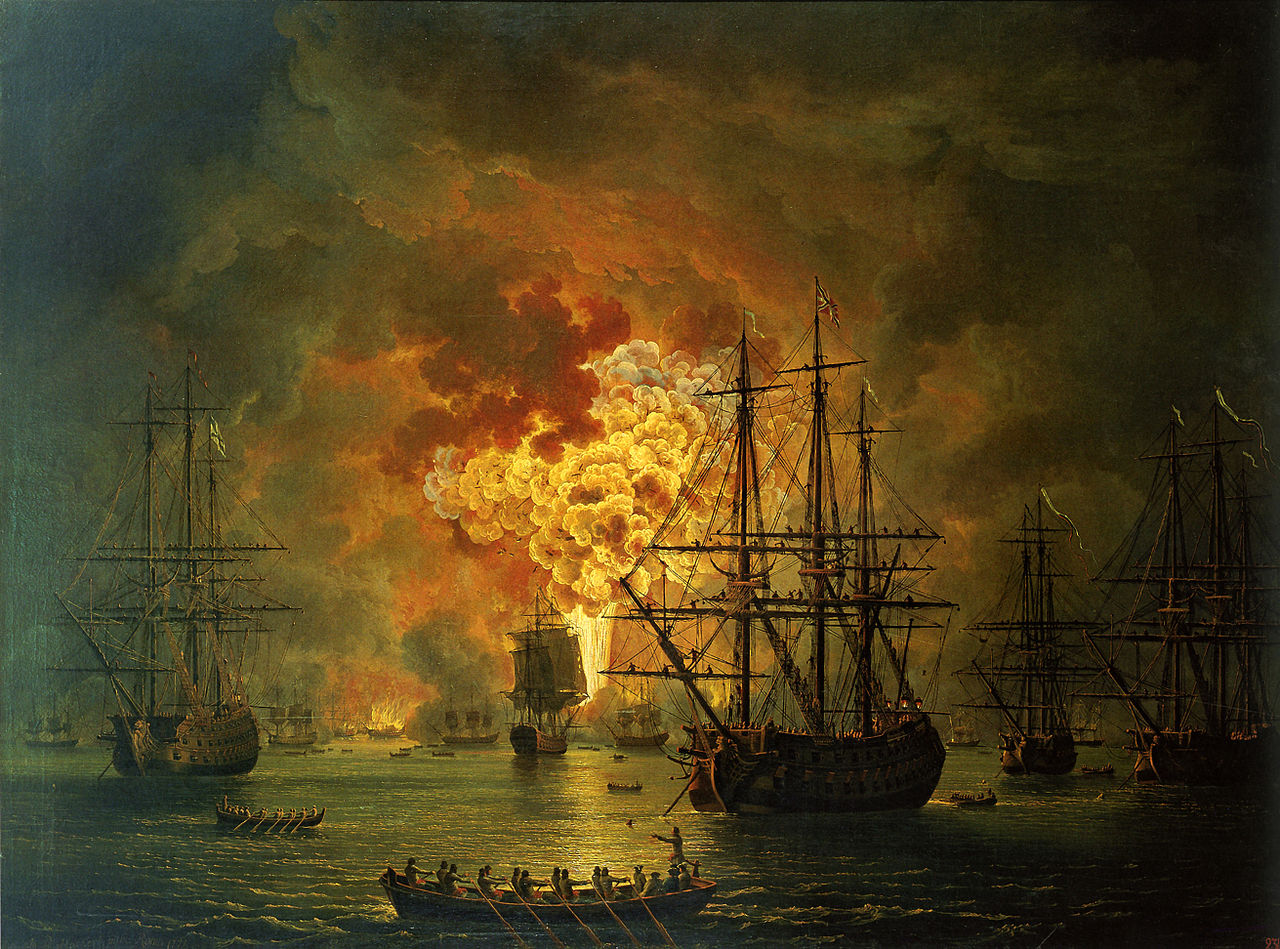
The destruction of the Turkish fleet in the Battle of Chesme, 1770.
Just outside the city of Chesmeon June 24, 1770, twelve Russian ships engaged twenty-two Turkish vessels and destroyed them with the use of fire ships. The defeat at Chesme demoralized the Ottomans, and bolstered Russian morale. Catherine II used this and other victories over the Turks to consolidate her reign over Russia domestically by commissioning medals in honour of the battle. Despite their naval successes, the Russians were unable to capture Constantinople because of Ottoman fortifications as well as European concerns that victory would upset the balance of power.
In 1771, Ali Bey al-Kabir, the Mamluk usurper of Egypt, allied with Zahir al-Umar, the autonomous sheikh of Acre, against their Ottoman overlords. The Egyptian general Abu al-Dhahab marched on Damascus, but the Ottoman governor, Uthman Pasha al-Kurji, convinced him to turn on his erstwhile master. Abu al-Dhahab then marched on Egypt and forced Ali Bey to flee to Zahir. Now, Count Orlov, with Catherine's approval, intervened and established friendly relations with the two anti-Ottoman rebels. The Russian fleet provided critical aid in the Battle of Sidon and it bombarded and occupied Beirut. The Russians surrendered Beirut to the pro-Ottoman emir of Mount Lebanon, Yusuf Shihab, only after being paid a large ransom.
In 1773, Yusuf Shihab entrusted the strengthening of Beirut's defences to Ahmad al-Jazzar. When the latter began to act independently, Yusuf got into contact with Zahir al-Umar to remove him. Zahir suggested that they enlist the Russians. The Russian squadron, under Captain Ivan Kozhukov, blockaded and bombarded Beirut while Zahir negotiated Jazzar's withdrawal. The latter then entered Zahir's service, only to rebel against him after a few months. In consequence, the Russians occupied Beirut for a second time, for four months, to force Yusuf to pay a ransom.
Mediation and ceasefire
Prussia, Austria and Great Britain offered to mediate the dispute between Russia and the Ottomans to halt Russia's expansion. Austria managed to turn the situation to its advantage by gaining physical land concessions from the Ottomans with a treaty on July 6, 1771. The Austrians maintained their increased military presence on their border with Moldavia and Wallachia, and they increased a subsidy to the cash-starved Ottomans, who had been dabbling in tax farming) and offered unsubstantiated support to the Ottomans against Russia. Catherine II, wary of the proximity of the Austrian army to her own forces and fearing an all-out European war, accepted the loss of Poland and agreed to Frederick II’s plan to partition Poland. She secretly agreed to return the captured principalities back to the Ottomans, thereby removing Austria's fear of a powerful Russian Balkan neighbour. On April 8, 1772, Kaunitz, the Austrian equivalent of Minister of Foreign affairs, informed the Porte that Austria no longer considered the treaty of 1771 binding.
A ceasefire between Russia and the Ottoman Empire commenced on May 30, 1772, but real negotiations did not begin until August 8. The peace talks broke down almost immediately over the Crimea, but the truce was extended until March 20, 1773.
Both parties had reasons to expand the negotiations, primarily to do with both sides wanting to keep fighting on a single front. The Ottomans were now quelling rebellions from Egypt and Syria and also faced incursions from Persia. The Russians were facing a revival of a centralized Sweden, which had undergone a coup from King Gustav III.
Final Russian offensive
On June 20, 1774, the Russian army, under the command of Alexander Suvorov, managed to rout the Ottoman Army near Kozludzha. Russia used the victory to force the Ottoman Empire to acquiesce to Russia's preferences in the treaty.
Peace treaty
On July 21, 1774, the Ottoman Empire had to sign perforce the Treaty of Küçük Kaynarca. The treaty did not overtly take away vast territories from the Ottomans — Poland had already paid the price of alienated territory. According to the treaty:
The Crimean Khanate formally gained its independence from both powers (but in reality became dependent on Russia and in 1782 was directly annexed after bloody clashes between the Christian and Tatar population).
Russia received war reparations of 4.5 million rubles
the Ottoman Empire ceded to Russia two key seaports, Azov and Kerch, allowing the Russian Navy and merchant fleet direct access to the Black Sea
the Porte renounced Ottoman claims to Kabarda in the North Caucasus
Russia gained official status as protector of the OrthodoxChristians living in the Ottoman Empire, which opened the door for future Russian expansion
As a consequence of the treaty, the Ottomans ceded the northwestern part of Moldavia (later known as Bukovina) to the Habsburg Empire.
Russia quickly exploited Küçük Kaynarca for an easy excuse to go to war and take more territory from the Ottoman Empire.
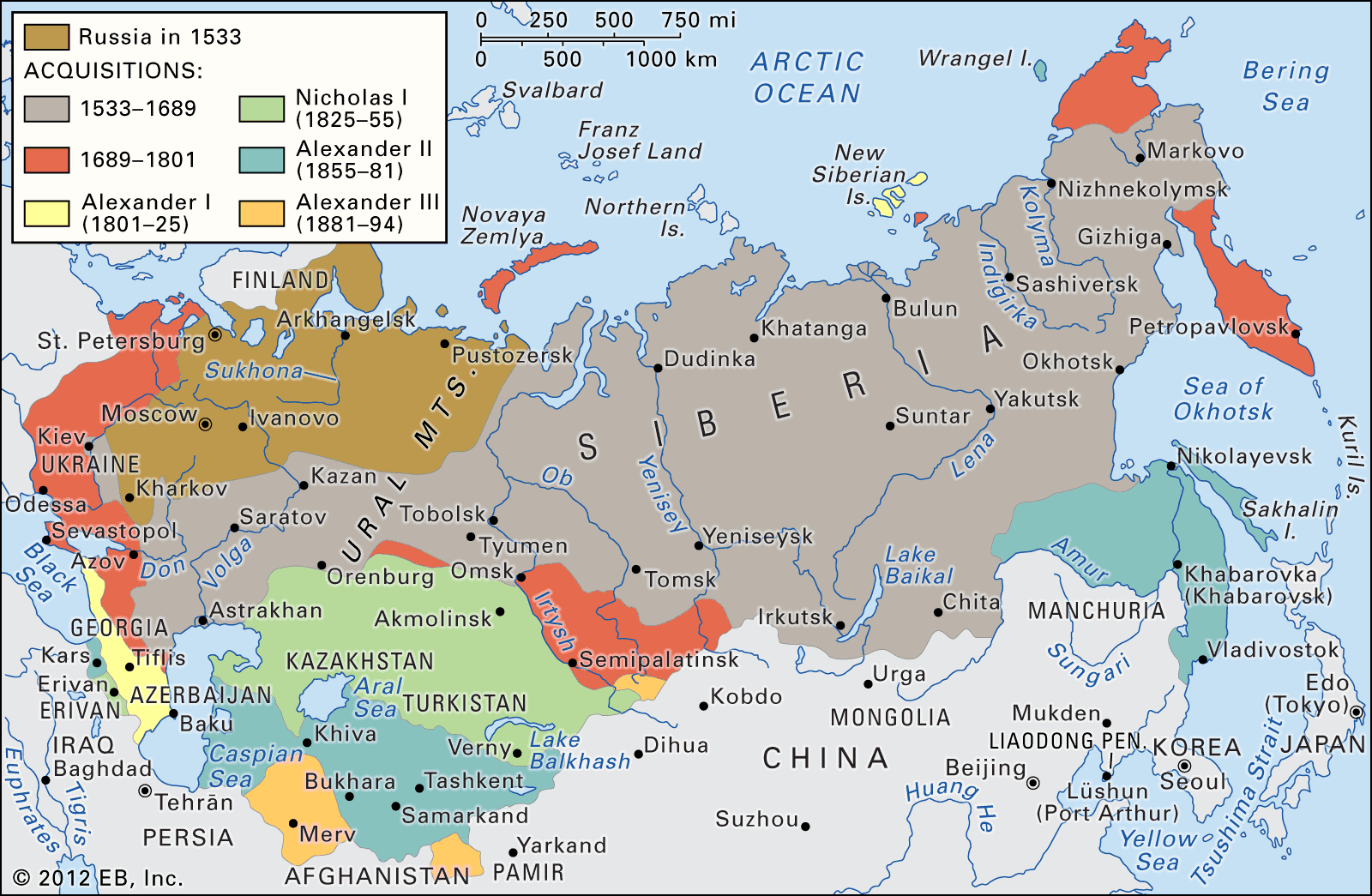
This war comprised but a small part of the continuous process of expansion of the Russian Empire southwards and eastwards during the 18th and 19th centuries.
Russo-Turkish wars, series of wars between Russia and the Ottoman Empirein the 17th-19th century. The wars reflected the decline of the Ottoman Empire and resulted in the gradual southward extension of Russia’s frontier and influence into Ottoman territory. The wars took place in 1676-81, 1687, 1689, 1695-96, 1710-12 (part of the Great Northern War), 1735-39, 1768-74, 1787-91, 1806-12, 1828-29, 1853-56 (the Crimean War), and 1877-78. As a result of these wars, Russia was able to extend its European frontiers southward to the Black Sea, southwestward to the Prut River, and south of the Caucasus Mountains in Asia.
The early Russo-Turkish Wars were mostly sparked by Russia’s attempts to establish a warm-water port on the Black Sea, which lay in Turkish hands. The first war (1676–81) was fought without success in Ukraine west of the Dnieper River by Russia, which renewed the war with failed invasions of Crimea in 1687 and 1689. In the war of 1695-96, the Russian tsar Peter I the Great’s forces succeeded in capturing the fortress of Azov. In 1710 Turkey entered the Northern War against Russia, and after Peter the Great’s attempt to liberate the Balkans from Ottoman rule ended in defeat at the Prut River (1711), he was forced to return Azov to Turkey. War again broke out in 1735, with Russia and Austria in alliance against Turkey. The Russians successfully invaded Turkish-held Moldavia, but their Austrian allies were defeated in the field, and as a result the Russians obtained almost nothing in the Treaty of Belgrade(September 18, 1739).
The first major Russo-Turkish War (1768-74) began after Turkey demanded that Russia’s ruler, Catherine II the Great, abstain from interfering in Poland’s internal affairs. The Russians went on to win impressive victories over the Turks. They captured Azov, Crimea, and Bessarabia, and under Field Marshal P.A. Rumyantsev they overran Moldavia and also defeated the Turks in Bulgaria. The Turks were compelled to seek peace, which was concluded in the Treaty of Küçük Kaynarca (July 21, 1774). This treaty made the Crimean khanate independent of the Turkish sultan; advanced the Russian frontier southward to the Southern (Pivdennyy) Buh River; gave Russia the right to maintain a fleet on the Black Sea; and assigned Russia vague rights of protection over the Ottoman sultan’s Christian subjects throughout the Balkans.
Russia was now in a much stronger position to expand, and in 1783 Catherine annexed the Crimean Peninsula outright. War broke out in 1787, with Austria again on the side of Russia (until 1791). Under General A.V. Suvorov, the Russians won several victories that gave them control of the lower Dniester and Danube rivers, and further Russian successes compelled the Turks to sign the Treaty of Jassy (Iaşi) on January 9, 1792. By this treaty Turkey ceded the entire western Ukrainian Black Sea coast (from the Kerch Strait westward to the mouth of the Dniester) to Russia.
Russia was now in a much stronger position to expand, and in 1783 Catherine annexed the Crimean Peninsula outright. War broke out in 1787, with Austria again on the side of Russia (until 1791). Under General A.V. Suvorov, the Russians won several victories that gave them control of the lower Dniester and Danube rivers, and further Russian successes compelled the Turks to sign the Treaty of Jassy (Iaşi) on January 9, 1792. By this treaty Turkey ceded the entire western Ukrainian Black Sea coast (from the Kerch Strait westward to the mouth of the Dniester) to Russia.
When Turkey deposed the Russophile governors of Moldavia and Walachia in 1806, war broke out again, though in a desultory fashion, since Russia was reluctant to concentrate large forces against Turkey while its relations with Napoleonic France were so uncertain. But in 1811, with the prospect of a Franco-Russian war in sight, Russia sought a quick decision on its southern frontier. The Russian field marshal M.I. Kutuzov’s victorious campaign of 1811–12 forced the Turks to cede Bessarabia to Russia by the Treaty of Bucharest (May 28, 1812).
Russia had by now secured the entire northern coast of the Black Sea. Its subsequent wars with Turkey were fought to gain influence in the Ottoman Balkans, win control of the Dardanelles and Bosporus straits, and expand into the Caucasus. The Greeks’ struggle for independence sparked the Russo-Turkish War of 1828–29, in which Russian forces advanced into Bulgaria, the Caucasus, and northeastern Anatolia itself before the Turks sued for peace. The resulting Treaty of Edirne (September 14, 1829) gave Russia most of the eastern shore of the Black Sea, and Turkey recognized Russian sovereignty over Georgia and parts of present-day Armenia.
The war of 1853-56, known as the Crimean War, began after the Russian emperor Nicholas I tried to obtain further concessions from Turkey. Great Britain and France entered the conflict on Turkey’s side in 1854, however, and the Treaty of Paris (March 30, 1856) that ended the war was a serious diplomatic setback for Russia, though involving few territorial concessions.
The last Russo-Turkish War (1877-78) was also the most important one. In 1877 Russia and its ally Serbia came to the aid of Bosnia and Herzegovina and Bulgaria in their rebellions against Turkish rule. The Russians attacked through Bulgaria, and after successfully concluding the Siege of Pleven they advanced into Thrace, taking Adrianople (now Edirne, Tur.) in January 1878. In March of that year Russia concluded the Treaty of San Stefano with Turkey. This treaty freed Romania, Serbia, and Montenegro from Turkish rule, gave autonomy to Bosnia and Herzegovina, and created a huge autonomous Bulgaria under Russian protection. Britain and Austria-Hungary, alarmed by the Russian gains contained in the treaty, compelled Russia to accept the Treaty of Berlin (July 1878), whereby Russia’s military-political gains from the war were severely restricted.
From 1568 to 1918, the Russo-Turkish wars were one of the most important military conflicts that have ever occured in Europe. This video contains all the Russo-Turkish Wars..
The Crimean Khanate in about 1600.
Note that the areas marked Poland and especially Muscovy were claimed rather than administered and were thinly populated.
The Crimean Khanate(Crimean Tatar:Qırım Hanlığıقرم خانلغى or Qırım Yurtu, قرم يورتى) was a Turkic state existing from 1441 to 1783, the longest-lived of the Turkic khanates that succeeded the empire of the Golden Horde. Established by Hacı I Giray in 1441, the Crimean khans were the patrilineal descendants of Toqa Temür, thirteenth son of Jochi and grandson of Genghis Khan through marriage; Temür married one of Genghis Khan's granddaughters. The khanate was located in present-day Moldova, Russia and Ukraine.
Ottoman forces under Gedik Ahmet Pasha conquered all of the Crimean peninsula and joined it to the khanate in 1475.In 1774, it was released as a sovereign political entity, following the Russo-Turkish Treaty of Küçük Kaynarca, and annexed by the Russian Empire in 1783, becoming the Taurida Governorate. Though, according to a well-known Russian historian, Doctor of Historical Sciences, professor of the Russian Academy of Sciences Zaitsev Ilya Vladimirovich, the Crimean Khanate was an independent state during all its history.
Naming and geography
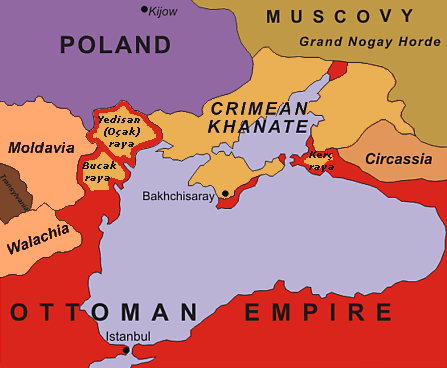
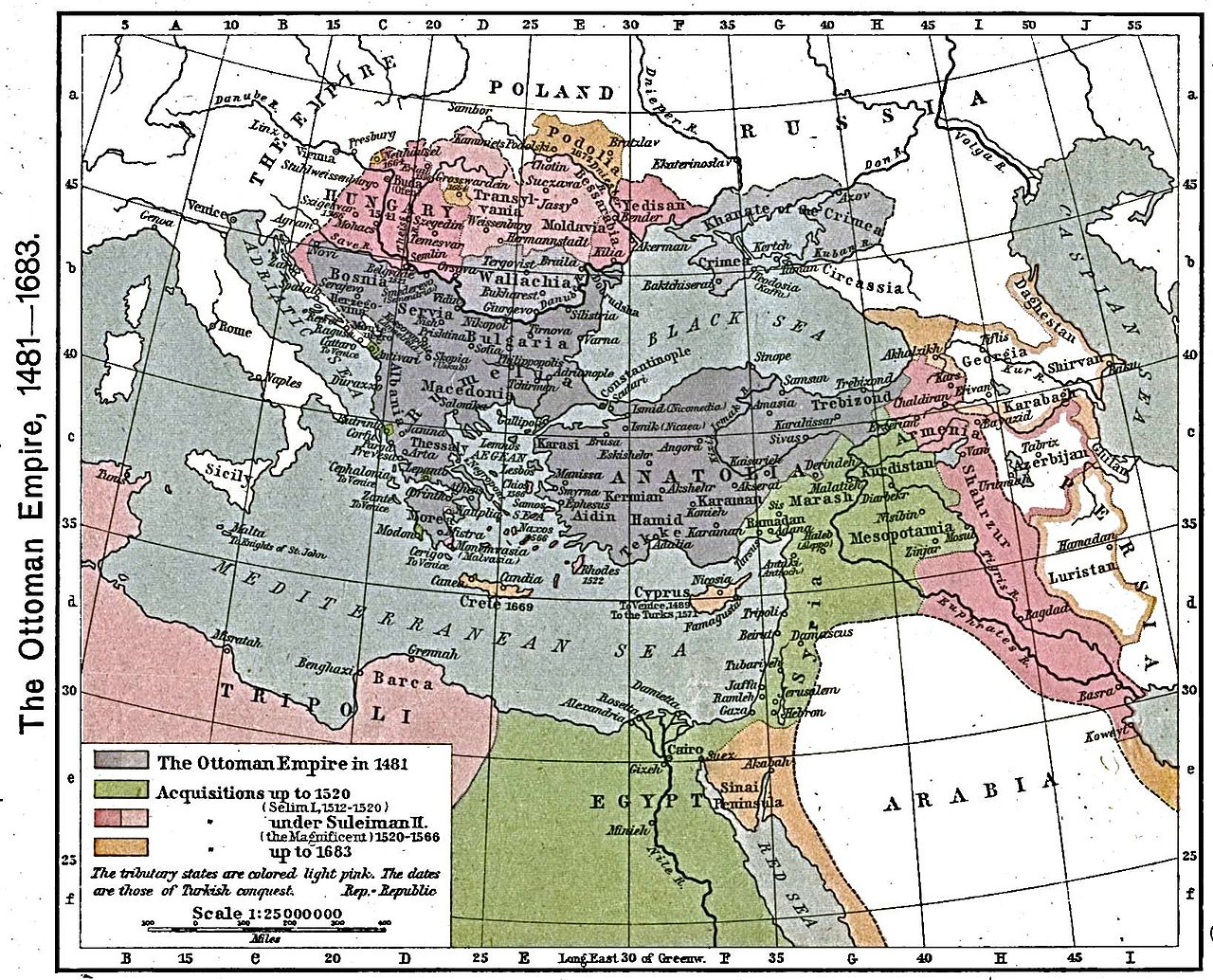
Map of the Crimean Khanate and the Ottoman Empire.
English-speaking writers during the 18th and early 19th centuries often called the territory of the Crimean Khanate and of the Lesser Nogai HordeLittle Tartary (or subdivided it as Crim Tartary (also Krim Tartary) and Kuban Tartary). The name "Little Tartary" distinguished the area from (Great) Tartary — those areas of central and northern Asia inhabited by Turkic peoples or Tatars.
The London-based cartographer Herman Moll in a map of c. 1729 shows "Little Tartary" as including the Crimean peninsula and the steppe between Dnieper and Mius River as far north as the Dnieper bend and the upper Tor River (a tributary of the Donets).
History
Establishment
The Crimean Khanate originated in the early 15th century when certain clans of the Golden Horde Empire ceased their nomadic life in the Desht-i Kipchak (Kypchak Steppes of today's Ukraine and southern Russia) and decided to make Crimea their yurt (homeland). At that time, the Golden Horde of the Mongol empire had governed the Crimean peninsula as an ulus since 1239, with its capital at Qirim (Staryi Krym). The local separatists invited a Genghisid contender for the Golden Horde throne, Hacı Giray, to become their khan. Hacı Giray accepted their invitation and traveled from exile in Lithuania. He warred for independence against the Horde from 1420 to 1441, in the end achieving success. But Hacı Giray then had to fight off internal rivals before he could ascend the throne of the khanate in 1449, after which he moved its capital to Qırq Yer (today part of Bahçeseray). The khanate included the Crimean Peninsula (except the south and southwest coast and ports, controlled by the Republic of Genoa & Trebizond Empire) as well as the adjacent steppe.
Ottoman protectorate
The sons of Hacı I Giray contended against each other to succeed him. The Ottomans intervened and installed one of the sons, Meñli I Giray, on the throne. Menli I Giray, took the imperial title "Sovereign of Two Continents and Khan of Khans of Two Seas."
In 1475 the Ottoman forces, under the command of Gedik Ahmet Pasha, conquered the Greek Principality of Theodoro and the Genoese colonies at Cembalo, Soldaia, and Caffa (modern Feodosiya). Thenceforth the khanate was a protectorate of the Ottoman Empire. The Ottoman sultan enjoyed veto power over the selection of new Crimean khans. The Empire annexed the Crimean coast but recognized the legitimacy of the khanate rule of the steppes, as the khans were descendants of Genghis Khan.
In 1475, the Ottomans imprisoned Meñli I Giray for three years for resisting the invasion. After returning from captivity in Constantinople, he accepted the suzerainty of the Ottoman Empire. Nevertheless, Ottoman sultans treated the khans more as allies than subjects. The khans continued to have a foreign policy independent from the Ottomans in the steppes of Little Tartary. The khans continued to mint coins and use their names in Friday prayers, two important signs of sovereignty. They did not pay tribute to the Ottoman Empire;instead the Ottomans paid them in return for their services of providing skilled outriders and frontline cavalry in their campaigns. Later on, Crimea lost power in this relationship as the result of a crisis in 1523, during the reign of Meñli's successor, Mehmed I Giray. He died that year and beginning with his successor, from 1524 on, Crimean khans were appointed by the Sultan.
The alliance of the Crimean Tatars and the Ottomans was comparable to the Polish-Lithuanian Union in its importance and durability. The Crimean cavalry became indispensable for the Ottomans' campaigns against Poland, Hungary, and Persia.
Victory over the Golden Horde
In 1502, Meñli I Giray defeated the last khan of the Great Horde, which put an end to the Horde's claims on Crimea. The Khanate initially chose as its capital Salaçıq near the Qırq Yer fortress. Later, the capital was moved a short distance to Bahçeseray, founded in 1532 by Sahib I Giray. Both Salaçıq and the Qırq Yer fortress today are part of the expanded city of Bahçeseray.
Slave trade
The slave trade was the backbone of the economy of the Crimean Khanate. However, other historians are sure that the role of the slave trade in the economy of the Crimean Khanate is greatly exaggerated by modern historians, and the raiding economy is nothing but a historical myth.
The Crimeans frequently mounted raids into the Danubian principalities, Poland-Lithuania, and Muscovy to enslave people whom they could capture; for each captive, the khan received a fixed share (savğa) of 10% or 20%. These campaigns by Crimean forces were either sefers ("sojourns"), officially declared military operations led by the khans themselves, or çapuls ("despoiling"), raids undertaken by groups of noblemen, sometimes illegally because they contravened treaties concluded by the khans with neighbouring rulers.
For a long time, until the early 18th century, the khanate maintained a massive slave trade with the Ottoman Empire and the Middle East, exporting about 2 million slaves from Russia and Poland-Lithuania over the period 1500-1700. Caffa (an Ottoman city on Crimean peninsula) was one of the best known and significant trading ports and slave markets, although it could not influence Crimean Khanate economics, as Caffa was a part of Ottoman Empire, not Crimean Khanate.In 1769, a last major Tatar raid resulted in the capture of 20,000 Russian and Ruthenian slaves.
"Fisher estimates that in the sixteenth century the Polish–Lithuanian Commonwealth lost around 20,000 individuals a year and that from 1474 to 1694, as many as a million Commonwealth citizens were carried off into Crimean slavery."
Early modern sources are full of descriptions of sufferings of Christian slaves captured by the Crimean Tatars in the course of their raids:
"It seems that the position and everyday conditions of a slave depended largely on his/her owner. Some slaves indeed could spend the rest of their days doing exhausting labor: as the Crimean vizir (minister) Sefer Gazi Aga mentions in one of his letters, the slaves were often “a plough and a scythe” of their owners. Most terrible, perhaps, was the fate of those who became galley-slaves, whose sufferings were poeticized in many Ukrainian dumas (songs). ... Both female and male slaves were often used for sexual purposes."
📹 Qirimli Aziz Idris bey one of the founders of the Ottoman Red Crescent (VİDEO)
📹 Qirimli Aziz Idris bey one of the founders of the Ottoman Red Crescent (LINK)
One of the founders of the Ottoman organization of the Red Crescent was born in Crimea, Qirimli Aziz Idris Bey. He is also known for his works “Medical Chemistry” (Kimya-i Tıbbi) and “The Science of General Diseases” (İlm-i Emraz - i Umumiye), which for a long time were used as manuals at medical schools of the Ottoman Empire.
Catherine II, by J.B. Lampi (1780s, Kunsthistorisches Museum).
Catherine II (Russian: Екатери́на Алексе́евна, romanized: Yekaterina Alekseyevna; 2 May [O.S. 21 April] 1729 – 17 November [O.S. 6 November] 1796), most commonly known as Catherine the Great (Екатери́на Вели́кая, Yekaterina Velikaya), born Princess Sophie of Anhalt-Zerbst, was Empress of Russia from 1762 until 1796, the country's longest-ruling female leader. She came to power following a coup d'état that she organised — resulting in her husband, Peter III, being overthrown. Under her reign, Russia was revitalised; it grew larger and stronger, and was recognised as one of the great powers of Europe.
Catherine reformed the administration of Russian guberniyas, and many new cities and towns were founded on her orders. An admirer of Peter the Great, Catherine continued to modernize Russia along Western European lines. However, military conscription and the economy continued to depend on serfdom, and the increasing demands of the state and of private landowners intensified the exploitation of serf labor. This was one of the chief reasons behind several rebellions, including the large-scale Pugachev Rebellion of Cossacks and peasants.
Catherine decided to have herself inoculated against smallpox by a British doctor, Thomas Dimsdale. While this was considered a controversial method at the time, she succeeded. Her son Pavel was later inoculated as well. Catherine then sought to have inoculations throughout her empire and stated: "My objective was, through my example, to save from death the multitude of my subjects who, not knowing the value of this technique, and frightened of it, were left in danger". By 1800, approximately 2 million inoculations (almost 6% of the population) were administered in the Russian Empire.
The period of Catherine the Great's rule, the Catherinian Era, is considered the Golden Age of Russia. The Manifesto on Freedom of the Nobility, issued during the short reign of Peter III and confirmed by Catherine, freed Russian nobles from compulsory military or state service. Construction of many mansions of the nobility, in the classical style endorsed by the Empress, changed the face of the country. She enthusiastically supported the ideals of the Enlightenment and is often regarded as an enlightened despot. As a patron of the arts she presided over the age of the Russian Enlightenment, including the establishment of the Smolny Institute for Noble Maidens, the first state-financed higher education institution for women in Europe.
Catherine the Great, Russian Yekaterina Velikaya, also called Catherine II, Russian in full Yekaterina Alekseyevna, original name Sophie Friederike Auguste, Prinzessin von Anhalt-Zerbst, (born April 21 [May 2, New Style], 1729, Stettin, Prussia [now Szczecin, Poland]—died November 6 [November 17], 1796, Tsarskoye Selo [now Pushkin], near St. Petersburg, Russia), German-born empress of Russia (1762–96) who led her country into full participation in the political and cultural life of Europe, carrying on the work begun by Peter the Great. With her ministers she reorganized the administration and law of the Russian Empire and extended Russian territory, adding Crimea and much of Poland.
What is Catherine the Great known for?
How did Catherine the Great come into power?
Catherine II, called Catherine the Great, reigned over Russia for 34 years—longer than any other female in Russian history. As empress, Catherine westernized Russia. She led her country into full participation in the political and cultural life of Europe. She championed the arts and reorganized the Russian law code. She also significantly expanded Russian territory. Today Catherine is a source of national pride for many Russians.
Catherine the Great was born Sophie von Anhalt-Zerbst to Prussian prince Christian August von Anhalt-Zerbst. At age 16, she married Karl Ulrich (later Peter III), the heir to the throne of Russia. Shortly after Ulrich ascended the throne, Catherine led a successful rebellion against him. Ulrich abdicated, and in September 1762 Catherine was crowned empress of Russia.
What was the Instruction of Catherine the Great?
How did Catherine the Great die?
The Instruction of Catherine the Great was a Russian political document prepared by the empress as a guide for a legislative commission considering internal reforms. In it Catherine “instructed” the commission to create a new legal code and recommended a series of government reforms based on liberal humanitarian political theories. According to the Instruction:
All men should be considered equal before the law.
The law should protect, not oppress, the people.
The law should only forbid harmful acts.
Serfdom should be abolished.
Capital punishment and torture should cease.
The principle of absolutism should be upheld.
Contrary to popular belief, Catherine the Great did not die on the toilet. She did, however, suffer a stroke in the toilet (meaning bathroom) and died the next day, on November 6 (November 17, New Style), 1796. The rumour that Catherine died on the toilet likely originated in the imperial Russian court. Catherine’s enemies in the court spread many different rumours about her death. One particularly nasty rumour held that Catherine had died while attempting sexual intercourse with a horse.
Origins And Early Experience
Sophie Friederike Auguste, Prinzessin (princess) von Anhalt-Zerbst, was the daughter of an obscure German prince, Christian August von Anhalt-Zerbst, but she was related through her mother to the dukes of Holstein. At age 14 she was chosen to be the wife of Karl Ulrich, duke of Holstein-Gottorp, grandson of Peter the Great and heir to the throne of Russia as the grand duke Peter. In 1744 Catherine arrived in Russia, assumed the title of Grand Duchess Catherine Alekseyevna, and married her young cousin the following year. The marriage was a complete failure; the following 18 years were filled with disappointment and humiliation for her.
Russia at the time was ruled by Peter the Great’s daughter, the empress Elizabeth, whose 20-year reign greatly stabilized the monarchy. Devoted to much pleasure and luxury and greatly desirous of giving her court the brilliancy of a European court, Elizabeth prepared the way for Catherine.
Catherine, however, would not have become empress if her husband had been at all normal. He was extremely neurotic, rebellious, obstinate, perhaps impotent, nearly alcoholic, and, most seriously, a fanatical worshipper of Frederick II of Prussia, the foe of the empress Elizabeth. Catherine, by contrast, was clearheaded and ambitious. Her intelligence, flexibility of character, and love of Russia gained her much support.
She was humiliated, bored, and regarded with suspicion while at court, but she found comfort in reading extensively and in preparing herself for her future role as sovereign. Although a woman of little beauty, Catherine possessed considerable charm, a lively intelligence, and extraordinary energy. During her husband’s lifetime alone, she had at least three lovers; if her hints are to be believed, none of her three children, not even the heir apparent Paul, was fathered by her husband. Her true passion, however, was ambition; since Peter was incapable of ruling, she saw quite early the possibility of eliminating him and governing Russia herself.
The empress Elizabeth died on December 25, 1761 (January 5, 1762, New Style), while Russia, allied with Austria and France, was engaged in the Seven Years’ War against Prussia. Shortly after Elizabeth’s death, Peter, now emperor, ended Russia’s participation in the war and concluded an alliance with Frederick II of Prussia. He made no attempt to hide his hatred of Russia and his love of his native Germany; discrediting himself endlessly by his foolish actions, he also prepared to rid himself of his wife. Catherine had only to strike: she had the support of the army, especially the regiments at St. Petersburg, where Grigory Orlov, her lover, was stationed; the court; and public opinion in both capitals (Moscow and St. Petersburg). She was also supported by the “enlightened” elements of aristocratic society, since she was known for her liberal opinions and admired as one of the most cultivated persons in Russia. On June 28 (July 9, New Style), 1762, she led the regiments that had rallied to her cause into St. Petersburg and had herself proclaimed empress and autocrat in the Kazan Cathedral. Peter IIIabdicated and was assassinated eight days later. Although Catherine probably did not order the murder of Peter, it was committed by her supporters, and public opinion held her responsible. In September 1762, she was crowned with great ceremony in Moscow, the ancient capital of the tsars, and began a reign that was to span 34 years as empress of Russia under the title of Catherine II.
Early Years As Empress
Despite Catherine’s personal weaknesses, she was above all a ruler. Truly dedicated to her adopted country, she intended to make Russia a prosperous and powerful state. Since her early days in Russia she had dreamed of establishing a reign of order and justice, of spreading education, creating a court to rival Versailles, and developing a national culture that would be more than an imitation of French models. Her projects obviously were too numerous to carry out, even if she could have given her full attention to them.
Her most pressing practical problem, however, was to replenish the state treasury, which was empty when Elizabeth died; this she did in 1762 by secularizing the property of the clergy, who owned one-third of the land and serfs in Russia. The Russian clergy was reduced to a group of state-paid functionaries, losing what little power had been left to it by the reforms of Peter the Great. Since her coup d’etat and Peter’s suspicious death demanded both discretion and stability in her dealings with other nations, she continued to preserve friendly relations with Prussia, Russia’s old enemy, as well as with the country’s traditional allies, France and Austria. In 1764 she resolved the problem of Poland, a kingdom lacking definite boundaries and coveted by three neighbouring powers, by installing one of her old lovers, Stanisław Poniatowski, a weak man entirely devoted to her, as king of Poland.
Her attempts at reform, however, were less than satisfying. A disciple of the English and French liberal philosophers, she saw very quickly that the reforms advocated by Montesquieu or Jean-Jacques Rousseau, which were difficult enough to put into practice in Europe, did not at all correspond to the realities of an anarchic and backward Russia. In 1767 she convened a commission composed of delegates from all the provinces and from all social classes (except the serfs) for the purpose of ascertaining the true wishes of her people and framing a constitution. The debates went on for months and came to nothing. Catherine’s Instruction to the commission was a draft of a constitution and a code of laws. It was considered too liberal for publication in France and remained a dead letter in Russia.
Frustrated in her attempts at reform, Catherine seized the pretext of war with Turkey in 1768 to change her policy; henceforth, emphasis would be placed above all on national grandeur. Since the reign of Peter the Great, the Ottoman Empire had been the traditional enemy of Russia; inevitably, the war fired the patriotism and zeal of Catherine’s subjects. Although the naval victory at Çeşme in 1770 brought military glory to the empress, Turkey had not yet been defeated and continued fighting. At that point, Russia encountered unforeseen difficulties.
First, a terrible plague broke out in Moscow; along with the hardships imposed by the war, it created a climate of disaffection and popular agitation. In 1773 Yemelyan Pugachov, a former officer of the Don Cossacks, pretending to be the dead emperor Peter III, incited the greatest uprising of Russian history prior to the revolution of 1917. Starting in the Ural region, the movement spread rapidly through the vast southeastern provinces, and in June 1774 Pugachov’s Cossack troops prepared to march on Moscow. At this point, the war with Turkey ended in a Russian victory, and Catherine sent her crack troops to crush the rebellion. Defeated and captured, Pugachov was beheaded in 1775, but the terror and chaos he inspired were not soon forgotten. Catherine now realized that for her the people were more to be feared than pitied, and that, rather than freeing them, she must tighten their bonds.
Before her accession to power, Catherine had planned to emancipate the serfs, on whom the economy of Russia, which was 95 percent agricultural, was based. The serf was the property of the master, and the fortune of a noble was evaluated not in lands but in the “souls” he owned. When confronted with the realities of power, however, Catherine saw very quickly that emancipation of the serfs would never be tolerated by the owners, whom she depended upon for support, and who would throw the country into disorder once they lost their own means of support. Reconciling herself to an unavoidable evil without much difficulty, Catherine turned her attention to organizing and strengthening a system that she herself had condemned as inhuman. She imposed serfdom on the Ukrainians who had until then been free. By distributing the so-called crown lands to her favourites and ministers, she worsened the lot of the peasants, who had enjoyed a certain autonomy. At the end of her reign, there was scarcely a free peasant left in Russia, and, because of more systematized control, the condition of the serf was worse than it had been before Catherine’s rule.
Thus, 95 percent of the Russian people did not in any way benefit directly from the achievements of Catherine’s reign. Rather, their forced labour financed the immense expenditures required for her ever-growing economic, military, and cultural projects. In these undertakings, at least, she proved herself to be a good administrator and could claim that the blood and sweat of the people had not been wasted.
Influence Of Potemkin
In 1774, the year of Russia’s defeat of Turkey, Grigory Potemkin, who had distinguished himself in the war, became Catherine’s lover, and a brilliant career began for this official of the minor nobility, whose intelligence and abilities were equalled only by his ambition. He was to be the only one of Catherine’s favourites to play an extensive political role. Ordinarily, the empress did not mix business and pleasure; her ministers were almost always selected for their abilities. In Potemkin she found an extraordinary man whom she could love and respect and with whom she could share her power. As minister he had unlimited powers, even after the end of their liaison, which lasted only two years. Potemkin must be given part of the credit for the somewhat extravagant splendour of Catherine’s reign. He had a conception of grandeur that escaped the rather pedestrian German princess, and he understood the effect it produced on the people. A great dreamer, he was avid for territories to conquer and provinces to populate; an experienced diplomat with a knowledge of Russia that Catherine had not yet acquired and as audacious as Catherine was methodical, Potemkin was treated as an equal by the empress up to the time of his death in 1791. They complemented and understood each other, and the ambitious minister expressed his respect for his sovereign through complete devotion to her interests.
The annexation of Crimea from the Turks in 1783 was Potemkin’s work. Through that annexation and the acquisition of the territories of the Crimean khanate, which extended from the Caucasus Mountains to the Bug River in southwestern Russia, Russia held the north shore of the Black Sea and was in a position to threaten the existence of the Ottoman Empire and to establish a foothold in the Mediterranean. Catherine also sought to renew the alliance with Austria, Turkey’s neighbour and enemy, and renounced the alliance with Prussia and England, who were alarmed by Russian ambitions. Yet, during Catherine’s reign, the country did not become involved in a European war, because the empress scrupulously adhered to the territorial agreements she had concluded with several western European nations.
Russian expansion in Asia.
Catherine’s glorification reached its climax in a voyage to Crimea arranged by Potemkin in 1787. In a festive Arabian Nights atmosphere, the empress crossed the country to take possession of her new provinces; the emperor of Austria, the king of Poland, and innumerable diplomats came to honour her and to enjoy the splendours of what became known as “Cleopatra’s fleet” because Catherine and her court traveled partly by water. She dedicated new towns bearing her name and announced that she ultimately intended to proceed to Constantinople.
Effects Of The French Revolution
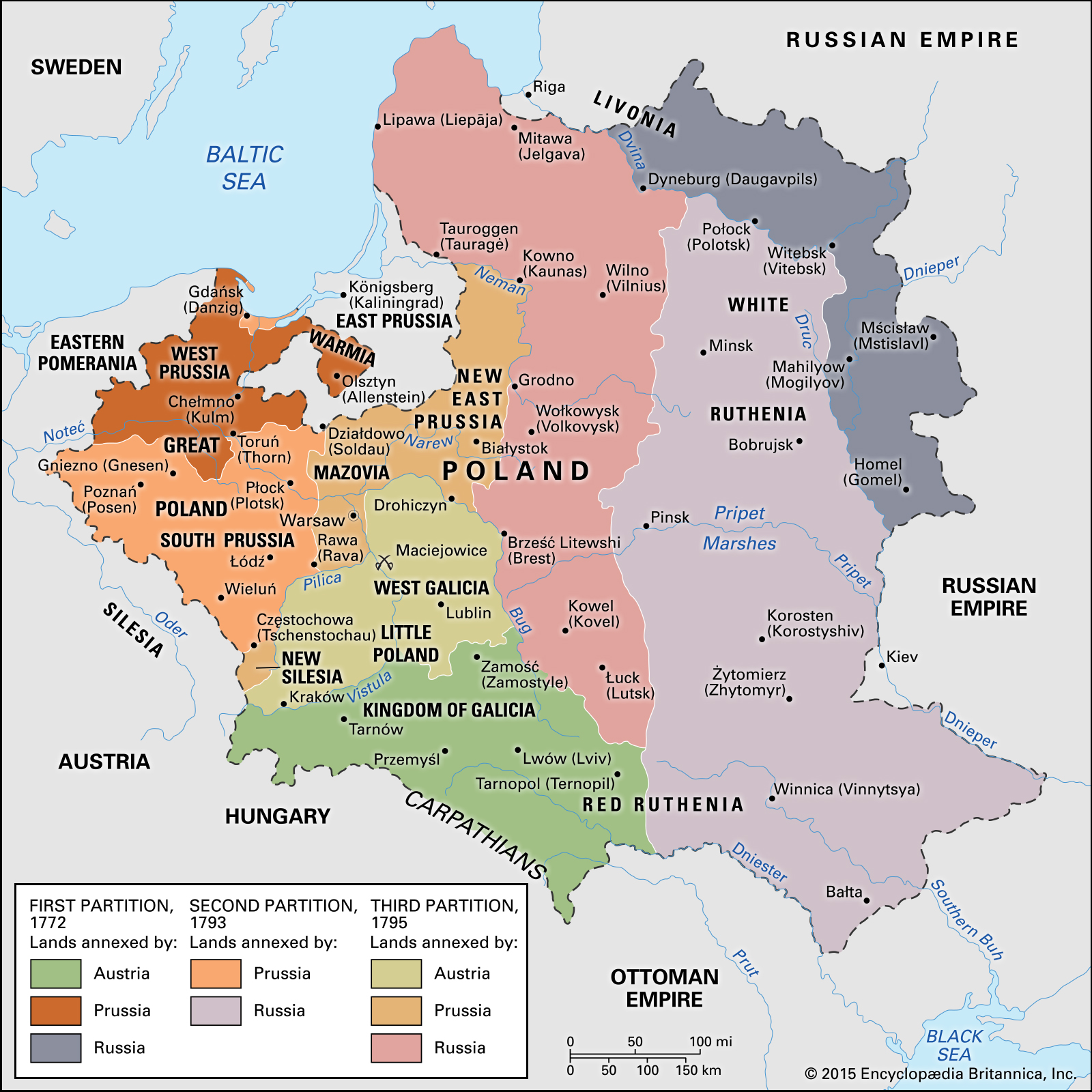
Catherine, like all the crowned heads of Europe, felt seriously threatened by the French Revolution. The divine right of royalty and the aristocracy was being questioned, and Catherine, although a “friend of the Enlightenment,” had no intention of relinquishing her own privileges: “I am an aristocrat, it is my profession.” In 1790 the writer A.N. Radishchev, who attempted to publish a work openly critical of the abuses of serfdom, was tried, condemned to death, then pardoned and exiled. Ironically, the sentiments Radishchev expressed were very similar to Catherine’s Instruction of 1767. Next, Poland, encouraged by the example of France, began agitating for a liberal constitution. In 1792, under the pretext of forestalling the threat of revolution, Catherine sent in troops and the next year annexed most of western Ukraine, while Prussia helped itself to large territories of western Poland. After the national uprising led by Tadeusz Kościuszko in 1794, Catherine wiped Poland off the map of Europe by dividing it between Russia, Prussia, and Austria in 1795.
Partitions of Poland, 1772-95.
Catherine’s last years were darkened by the execution of Louis XVI, the advance of the revolutionary armies, and the spread of radical ideas. The empress realized, moreover, that she had no suitable successor. She considered her son Paul an incompetent and unbalanced man; her grandson Alexander was too young yet to rule.
📹 Catherine II — Overview of Catherine II's early life and reign (VİDEO)
📹 Catherine II — Overview of Catherine II’s early life and reign (LINK)


.jpg)

--Abgebildete Person-Kaiserin Katharina II. v. Russland, Tochter v. C.A. Anhalt-Zerb.jpg)